oak veneer door repair
Veneer doors have a thin, outer layer that damages easily. Most of the time you don't even notice it, but if you hold a piece of fresh-cut plywood up at eye level and peer at the edge, you can see just how thin the veneer is. Typical veneer is usually no thicker than about 1/16 inch. It's bonded to the front of plywood with glue under pressure. It stays intact for a lifetime unless exposed to moisture, the glue fails or the edge of the veneer hooks on something and gets pulled loose. Other damages occur if the veneer is sanded too deep, scratched or gouged. You can repair almost any type of damage to veneer. Pulled Loose Loose veneer creates a flap, or a visible separation along the edge of a door. This type of damage is typically only a few inches long or wide. Repair loose veneer by inserting the tip of a putty knife into the crack. Clean out any loose chips or debris to allow the veneer to lay flat. Pry the flap up just enough to inject glue under it. If the flap won't lift up high enough, rub glue on the end of the knife and insert it into the crack, scraping the glue off inside and under the flap.

If the veneer is bubbled, and has no visible cracks, cut a small slit into the bubble and inject glue into the bubble. Place a thin piece of plastic over the crack or bubble. Use a padded clamp with cardboard or rubber to pad the door, and apply enough pressure to the flap or bubble to smash it down flat. If the bubble is in an area that you can't reach with a clamp, place a heavy object on it. Allow the glue to dry for at least one hour. Scrape off any residual glue with the putty knife. If the flap is less than 1 inch deep or long, you can also use masking tape instead of a clamp. Sanded Too Deep One of the worst problems occurs when veneer is sanded off. This happens during the building process, or when you're refinishing or repairing the door. It creates a void that reveals the core of the lumber below the veneer. Repair this type of damage by coloring it to match the existing woodwork. Use a matching stain marker to color the area to match the existing veneer on the door. When the stain dries, drag the tip of a darker marker across the damaged area to imitate grain lines.
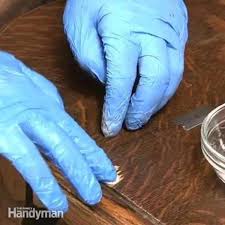
If you can still see the damage, try drawing the grain lines with a colored pencil, or even use the tip of a knife to score the damaged area slightly to imitate the grain pattern. Rub some wood putty over it and sand it lightly with 180-grit sandpaper. Spray the area lightly with a single coat of aerosol lacquer. If you can still see the area, drag the tip of the marker over the lacquered area and spray it again. Scratches and Gouges You can sand out many scratches on veneer doors. Attach 100-grit sandpaper to a hand-sanding block. Sand across the scratch parallel to the grain, back and forth gently until the scratch is gone. Carefully monitor the sanding process to prevent sanding through the veneer. If the grain lines around the scratch begin to disappear, stop sanding immediately. Apply a matching putty stick to the remaining parts of the scratch, followed by a matching oil stain. Spray the area lightly with one coat of aerosol lacquer. Repair deeper gouges with wood putty. This type of putty is specific to species.

Purchase the right putty to match the existing veneer on the door. Smash the putty hard into the gouge. Smear the putty to flatten it. When the putty is dry, sand the surface of the putty flush using 100-grit sandpaper. Draw grain lines on the putty using a stain marker. Finish by spraying lightly with lacquer. Structural Hollow core veneer doors sometimes separate. The outside plywood panel lifts from the frame of the door in one piece. This is often caused when something falls between the door and jamb.
patio screen door sweepWhen the door is shut tight, it lifts the 1/4-inch veneered panel off the door at the bottom corner.
double glazed door beadingFix this damage by removing the door from the hinges.
hotel door lock bypass
Place it across two sawhorses. Lift the plywood panel up as far as possible. Apply glue to the frame of the door under the plywood. Press the plywood back into place. Place padded clamps around the perimeter of the door where the plywood was loose. If the clamps won't reach far enough, place heavy objects in the center of the door to compress the plywood panel into the frame. Allow the glue to dry overnight before removing the clamps or the objects. Photo Credits Comstock/Comstock/Getty Images Suggest a Correction
where to buy barn door hardware in ontarioTo repair a hole in a wood-veneer door, you'll need a piece of replacement veneer and some very basic drawing skills. Here's how to do it: sawhorses flat-head screwdriver hammer utility knife ruler pencil and pen cardboard masking tape wood chisel medium-grit sandpaper wood glue towel gloves piece of replacement veneer stain or paint supplies (optional)

1. Remove the door from the hinges using a screwdriver and hammer and place across sawhorses. 2. Measure the size of the hole and draw a light reference line on the door bisecting the hole. 3. Draw an irregular shape large enough to encompass the hole on a lightweight piece of cardboard. Make the shape about ½-inch larger than the dimensions of the hole. The reason you want an irregular shape is that a square or circular patch on the veneer would be much more noticeable. A football-shaped patch works well. 4. Cut out the shape and attach a few doubled-up pieces of masking tape to the back. 5. Place the cardboard shape over the hole in the door and line it up with the reference line. 6. Score along the edge of the cutout. Go just deep enough to score the veneer; don't cut through the door, and be sure not to cut into the cardboard. 7. Mark the cardboard so you know which side is the top, and carefully peel it off the door. Be careful not to bend it, because you're going to use it as a template for your new patch.

8. Carefully deepen the score line on the door a bit, cutting just through the top layer of veneer. 9. Use a chisel to remove the top piece of veneer within the scored area. Smooth the exposed area with a piece of medium-grit sandpaper. 10. Hold your piece of replacement veneer up to the hole and try to match the grain pattern with that on the door. You probably won't match it perfectly; just get as close as you can. Stick your cardboard template on the area of veneer that matches best. 11. Cut around the template with the utility knife to create your veneer patch. 12. Test-fit the patch on the door. When it fits, coat the back of the patch with all-purpose glue. Spread the glue in an even layer. 13. Stick the patch on the door, twist it slightly to work it securely into place, cover it with a piece of plastic and place a heavy book on top. Allow the glue to set for 30 minutes. 14. Lightly sand the patch to smooth the edges, going with the grain. Touch up with a light coat of stain and give it a few minutes to dry.